Every enterprise AI search rollout hits the same wall. The pilot goes well on the wiki and the handbook, someone proposes connecting the finance drive or the customer folder, and the project stalls. The documents that would make the tool genuinely useful are exactly the ones nobody wants flowing into an index or a prompt.
That is not irrational caution. In a typical RAG stack, connected documents are copied into a search index as-is, and whatever a user types or pastes rides along to a language model on every question. If the model is a hosted API, sensitive values leave the building. Even when everything is self-hosted, raw identifiers end up duplicated in a new system that was never in the original data-governance map.
Permissions are necessary, not sufficient
The standard answer is permission-aware retrieval: only surface documents the person asking is already allowed to open. KnowWiz does this, and it matters. But permissions operate at the document level. A salesperson is allowed to open the contract they are working on. That does not mean the customer identifiers inside it should sit raw in a search index, or travel to a model on every question about payment terms.
Document-level access control answers who may see a document. It says nothing about what happens to the values inside documents as they move through an AI pipeline. That second question is the one that stalls rollouts.
What a data protection layer does
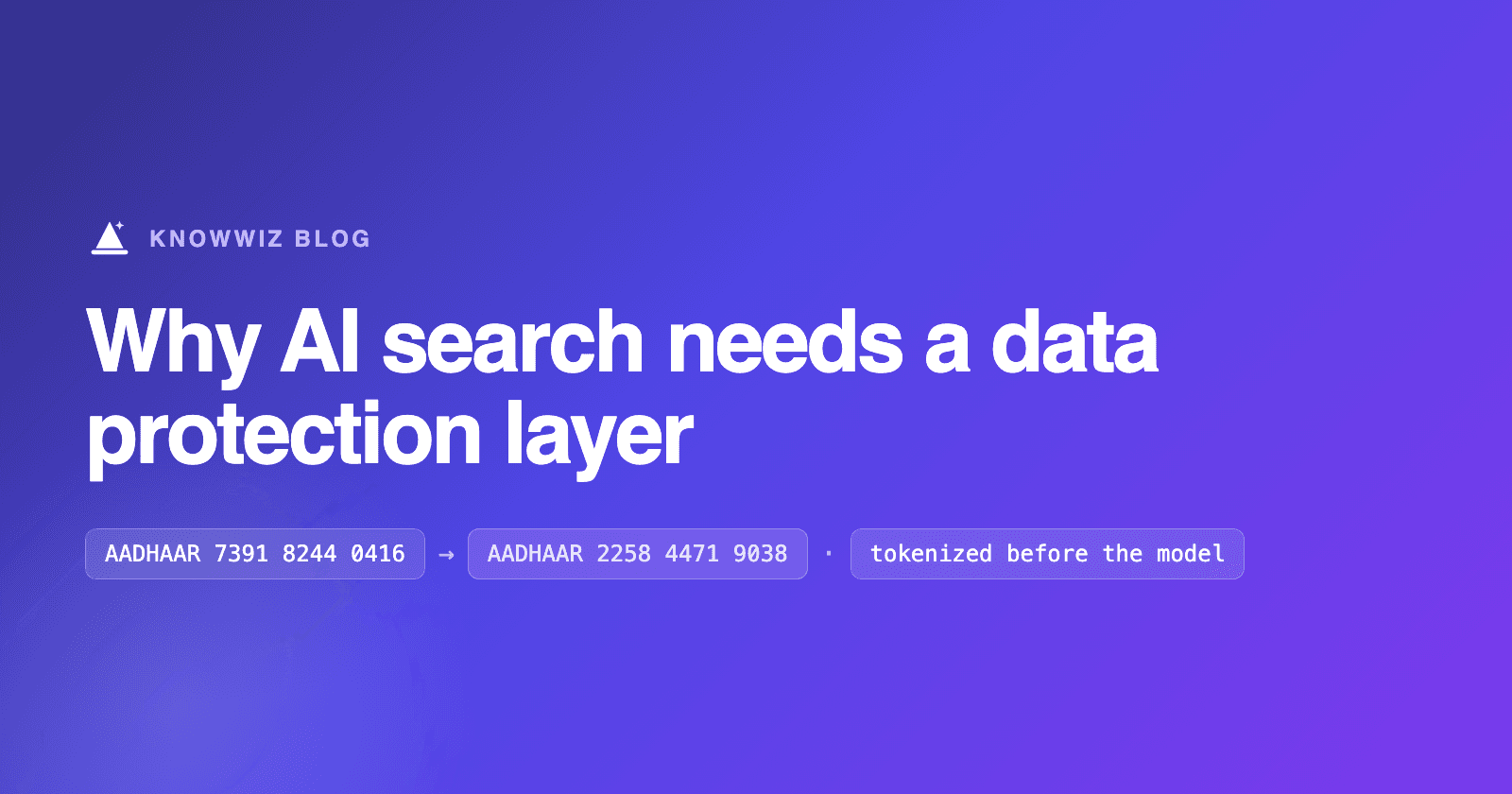
KnowWiz includes a data protection layer in the search pipeline itself. It detects sensitive values and replaces them with tokens at two points: before a document enters the index, and before a prompt reaches a model. The raw value is never written to the index and never sent for inference.
The tokens are format-preserving. An account number becomes something shaped like an account number, a phone number stays shaped like a phone number. That detail is what keeps the product usable: search still matches, the model still reasons about the relationships in the text, and answers still read naturally. Blunt redaction, the usual alternative, destroys exactly the structure that retrieval and reasoning depend on.
Detection and tokenization run entirely inside your deployment boundary, next to the index and the pipeline, and every detection and masking action is recorded. Nothing about the protection path adds an external dependency.
Built for the identifiers your regulators care about
Generic PII detection tuned on Western datasets misses the identifiers that matter most in the markets we serve first. KnowWiz detection covers regional identifiers including Aadhaar, PAN, and IFSC codes for India, and national IDs and IBANs for the Gulf, alongside the universal set of cards, emails, and phone numbers.
What ships today, and what comes next
Today the layer detects and tokenizes at ingestion and on the prompt, keeps values format-consistent, and audits every action. We are building toward policy-based reveal, where a value is unmasked in an answer only for a requester the policy explicitly allows. We will write about that when it ships, not before.
If the reason your AI search project is stuck is the sensitive half of your knowledge, this is the problem we built KnowWiz around. It is self-hosted, so the honest way to evaluate it is to run it on your own documents. The docs page covers deployment, and a working session with us takes thirty minutes.