Docker Compose
Bring the whole stack up on a single host with one compose file. The fastest way to stand up a pilot and try it on real documents.
KnowWiz is self-hosted, so the best evaluation is running it yourself. This page covers how it deploys, what it needs, how search works, and how to get a pilot going on your own infrastructure.
Deployment
Bring the whole stack up on a single host with one compose file. The fastest way to stand up a pilot and try it on real documents.
Production deployments use a Helm chart (Terraform and cloud guides included) so it fits your existing orchestration and scaling.
No outbound calls are required to run it. Point it at self-hosted models and it operates fully inside a disconnected network.
A lightweight chat-and-search stack that runs in under 1 GB of memory, for a quick trial or a small team.
How it works
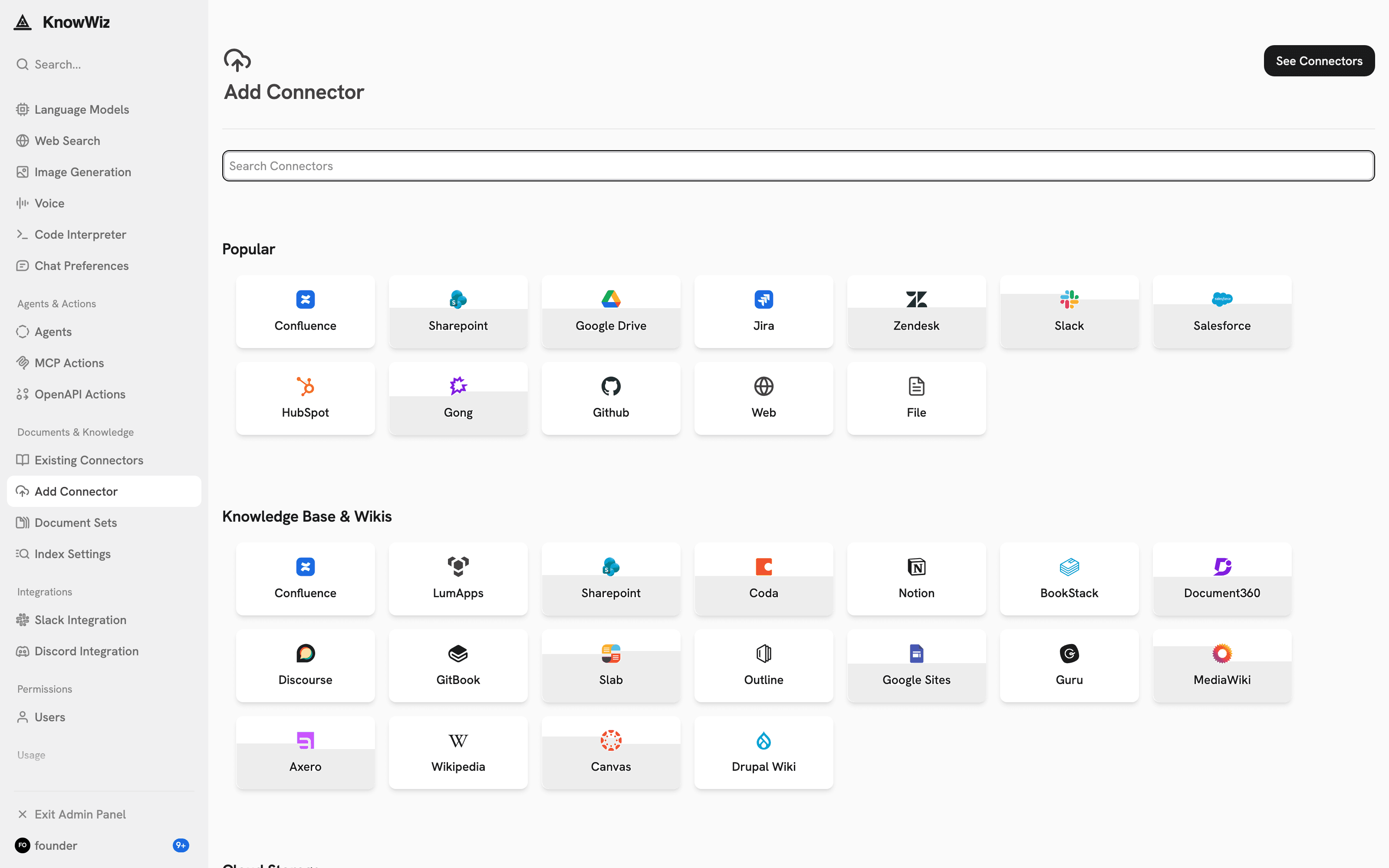
Point KnowWiz at your wikis, drives, tickets, chat, and code. 50+ connectors sync incrementally, picking up additions, edits, and deletions so the index stays current.
Add your wikis, drives, tickets, chat, and code from one screen. Connectors sync incrementally.
Evaluation questions
The honest answers, so you can judge fit before a call.
For a trial, it is a single Docker Compose file on one host, or Lite mode in under 1 GB of memory. For production, there is a Helm chart with Kubernetes, Terraform, and major-cloud guides. Most teams have a pilot answering questions on their own documents the same day they start.
Lite mode runs in under 1 GB of memory for a small team or a quick trial. The full stack runs the app, a Postgres database, the search index, and a model server, and is sized to your corpus and query volume. A pilot comfortably fits on a single mid-size VM; production scales horizontally under Kubernetes.
Retrieval is hybrid: keyword search for precision plus vector search for meaning, with reranking, then an agent that plans multiple searches for harder questions. Every answer cites the documents it used, so you can judge quality directly against your own content rather than taking a benchmark on faith. The fastest way to assess it is to index a real source and ask real questions.
50+ connectors out of the box, including Google Drive, SharePoint, Confluence, Notion, Slack, Teams, Jira, Zendesk, GitHub, and Salesforce, plus web pages, file uploads, and custom sources through MCP. Connectors sync incrementally.
Hosted models from Anthropic, OpenAI, or Gemini, or self-hosted models via Ollama, vLLM, or LiteLLM. You choose per deployment, and you can change providers later without re-indexing.
It stays with you. The index, the models (if self-hosted), and the pipeline all run inside your infrastructure. Knowledge Wizards does not receive or store your indexed content. In air-gapped mode there are no outbound calls at all.
Stand up a Docker Compose or Lite deployment, connect one source, and ask questions against it. If you want a hand sizing a production deployment or scoping a pilot, book a demo and an engineer will help.
Ready to try it
Stand up a pilot on your infrastructure, or book a working session and we will help you size and deploy it.
Self-hosted. Your data never leaves your environment.